
By: Cheryl Angelelli
Millions of women experience menopause, yet it remains one of the least openly discussed stages of life. For generations, the topic has been shrouded in silence—reduced to quiet whispers about hot flashes or mood swings—rather than treated as a major biological transition that can profoundly impact physical, emotional, and mental well-being. In recent years, public figures like Oprah Winfrey and Halle Berry have helped bring menopause into the spotlight by candidly sharing their own journeys, challenging stigma, and calling for better awareness, research, and medical training.
But even as this long-overdue conversation begins to grow, a significant group of women remains largely unseen and unheard: those living with neurological disabilities. If access to accurate information, understanding clinicians, and compassionate care is limited for most women going through perimenopause and menopause, it is even scarcer for women navigating these changes while managing conditions such as spinal cord injuries, multiple sclerosis, epilepsy, cerebral palsy, or traumatic brain injury. Their experiences often fall through the cracks of both neurology and women’s health, leaving them to face “the change” without tailored support or guidance.
My Personal Journey
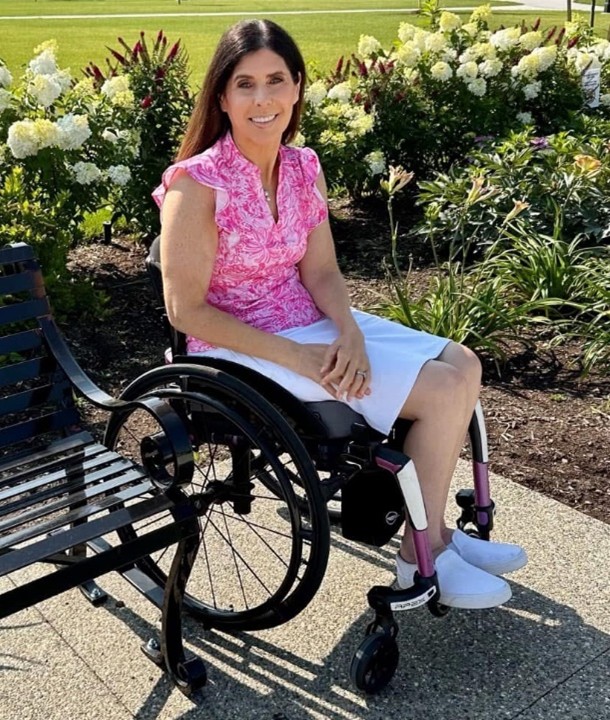
Before my own perimenopause and menopause journey began, the only thing I really associated with “the change” was hot flashes. As a quadriplegic with a spinal cord injury (SCI), I’m cold pretty much all the time—summer, winter, you name it—so I used to joke that I couldn’t wait for menopause to finally warm me up. Well, the universe must have a sense of humor, because the hot flashes never showed up…but an entire parade of unexpected symptoms sure did.
In 2020, my once long, thick, voluminous hair, which was the envy of all my girlfriends, began falling out at alarming rates. At the same time, I began to struggle with sleep, often only getting 3-4 hours on a good night. This was occurring during the start of the pandemic. I was working long, demanding hours for a major health system while carrying the worry that COVID-19 might strike the people I loved. I chalked up the physical changes I was experiencing as stress, never imagining it was actually perimenopause.
Perimenopause is the transitional phase leading up to menopause. During perimenopause, hormone levels like estrogen and progesterone start to fluctuate and decline, leading to irregular periods and other physical changes. Perimenopause often occurs during your 40s, but sometimes earlier or later. Perimenopause ends when you’ve gone 12 consecutive months without a period, at which point menopause officially starts.
I officially entered menopause in 2023, which came with even more biological changes. I’m still plagued with sleepless nights, and my hair still sheds but not at the rate it used to during perimenopause. I struggle with brain fog. I can literally walk into a room and forget what I came in there to do. Newer symptoms include difficulty staying focused at times and weight gain. I’ve also experienced dramatic changes in my bladder health. I have an urge to go to the bathroom more frequently, which means I intermittent cath more often, which has led to more urinary tract infections (UTIs). I was UTI-free for over 10 years until 2024, when I had four UTIs, all within months of each other. I worked with my urologist on an action plan, and I’m happy to report that I have been UTI-free for almost 12 months.
It's important to note that symptoms look different for everyone. In her New York Times bestseller, The New Menopause, Mary Claire Haver, MD, lists over 60 symptoms associated with perimenopause and menopause. Some of the most common are hot flashes, night sweats, mood swings, weight gain, difficulty sleeping, brain fog, and heart palpitations.
Challenges Faced by Women with Neurological Disabilities
When I started looking for information about menopause and SCI, I found very few researchers have studied what menopause looks like for women with neurological disabilities. The few studies that do exist mostly focus on women with SCI, and even those are limited.
From what researchers have found, women with spinal cord injuries tend to go through menopause around the same age as everyone else, but the symptoms can look and feel different. For example, one study showed that women with spinal cord injuries were less bothered by hot flashes but reported more bladder infections, sleep problems, and changes in sexual arousal. Another study found similar results — showing that our experience of menopause isn’t just about hormones, but how those changes interact with our bodies and injuries.
In addition, symptoms might be harder to recognize because of overlapping effects of SCI, like thermoregulation issues and impaired sensation that may mask or mimic typical menopausal symptoms. It makes sense when you think about it. Many of us already deal with things like temperature regulation issues, fatigue, or bladder changes — so it can be hard to tell what’s “menopause” and what’s “SCI.” Unfortunately, that overlap means our symptoms can be misunderstood or even dismissed.
Bone health is a major concern. SCI accelerates bone mineral density loss, and postmenopausal women with SCI are at particularly high risk for osteoporosis and fractures due to the combined effects of immobilization and loss of estrogen. The American Spinal Injury Association emphasizes the need for individualized bone health monitoring and preventive strategies.
Finding Help and Community
While finding a doctor that is knowledgeable about neurological disabilities and menopause might be a challenge, finding a certified menopause doctor is a good first step and can make a difference in how well you are supported. Certified menopause doctors, many of whom are OB/GYNs, have taken extra steps to specialize in menopause care, hormone therapy, bone health, and symptoms that don’t always get recognized. The Menopause Society has a “Find a Menopause Practitioner” directory you can use to search by zip code or state to find a certified menopause doctor near you.
Halle Berry’s menopause-focused website re-spin.com also helps women connect and find community with others going through menopause. While not specific to women with disabilities, it does provide valuable resources like expert-written articles on menopause, online peer support, and tips for navigating this stage of life.
It is clear that women with disabilities deserve to be included in conversations about menopause and in the science that shapes how healthcare providers support us. Until then, many of us are figuring it out on our own, comparing notes, and hoping the medical world catches up.
Sources:
Haver, M. C. (2024). The New Menopause: Navigating your path through hormonal change with purpose, power, and facts. Rodale Books.
Kalpakjian, C. Z. & Quint, E. H. (2009). Menopause research in women with spinal cord injury: Challenges and opportunities. Topics in Spinal Cord Injury Rehabilitation, 15(1), 75–90.
Kalpakjian, C. Z., Quint, E. H., Bushnik, T., Rodriguez, G. M., & Terrill, M. (2010). Menopause characteristics and subjective symptoms in women with and without spinal cord injury. Archives of Physical Medicine and Rehabilitation, 91(4), 562–569.